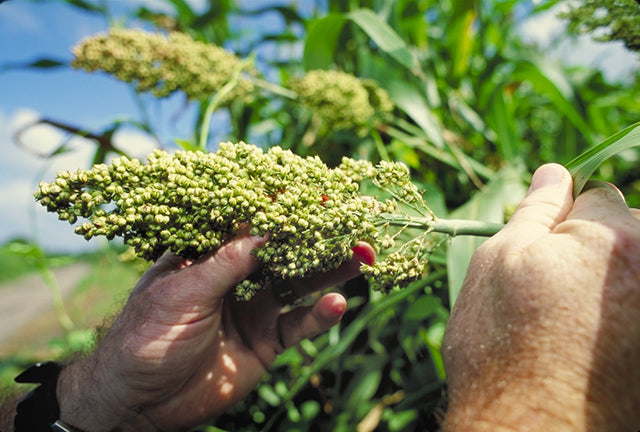

Drought-stressed forage can carry enough nitrate to make livestock sick, and the risk doesn't end when the rain returns. This guide covers when to test, how to sample, and what to do with the results. It applies to forage grasses (monocots) in general, including sudangrass, sorghum, and corn, as well as other forage plants that accumulate nitrate under stress.
The short version: After a drought-breaking rain, don't graze or cut right away. Test the forage just before you graze, cut, or feed, and if the result is high, hold off and retest.
Does rain make drought-stressed forage safe?
No. Nitrate can remain high after the rain, and new growth may be especially high in nitrate. Test before grazing or cutting rather than assuming a few days of rain or regrowth has made the forage safe.
Why drought raises nitrate
Water-stressed plants grow slowly or stop growing. Their roots still take up nitrate, but the plant uses less of it to build protein, so nitrate accumulates in the tissue, especially in the lower stalk.
When to test
- After drought-breaking rain, once growth has restarted. Don't graze or cut right away, since Michigan State University Extension reports that new growth can be exceptionally high in nitrate during the first 3 to 4 days. Don't treat the passage of a few days as proof that nitrate has fallen to a safe level.
- Before grazing, green chop, or harvest. This is the test that counts. A result today doesn't clear the crop next week, because nitrate levels can change with weather.
- Again if conditions change. Cloudy weather, frost, or another dry spell can change nitrate levels, so retest after any change.
If a result is high, wait and retest rather than grazing or cutting. Levels typically fall as the crop resumes normal growth.
How to sample
- Walk the field and collect from several spots, not just one.
- Sample the way the forage will be used. For hay, green chop, or silage, collect whole plants cut at the height you'll harvest. For grazing, include stems as well as leaves, since animals can eat more stem when forage is short. Nitrate is highest in the lower stems, so cutting low or grazing close raises the risk.
- Keep samples labeled by location so you can see where the problem areas are.
How to test
Green forage (you can squeeze sap)
Use the Green Forage Nitrate Test Kit. Squeeze sap with a garlic press, then follow the kit instructions to dilute and test it. Results take under an hour.
Dry forage (too dry to squeeze sap)
Use the Dry Forage Nitrate Test Kit. Grind or blend your sample, then follow the kit instructions to extract the nitrate with water and test it. You'll need a blender or grinder and distilled water. Results take under an hour. Drying does not reduce nitrate, so hay or other dry feed made from drought-stressed forage should be tested before feeding.
Silage
Ensiling can reduce nitrate, but doesn't always eliminate it, so testing is still worthwhile. The Green Forage kit can be used on a wet extract.
Reading the results
Compare your result to the Livestock Feeds and Forages Nitrate Toxicity Chart, which gives guidance by forage type and animal. Young, pregnant, and lactating animals are the most vulnerable. If a result is high, talk to your veterinarian or extension service about your options.
Sudangrass and sorghum: a second hazard
Sudangrass, sorghum, and sorghum-sudan hybrids can also accumulate cyanide (prussic acid) after drought stress, frost, or regrowth. So can Johnsongrass and shattercane, which often show up in hay fields and fence rows. This is separate from nitrate, and our kits don't test for it. See Drought, Sorghum, and a Double Poisoning Risk for more, and ask your state extension service about the risk in your area. If you suspect an animal has been poisoned, get stock off the feed and call a veterinarian right away.
General information only. Recommendations depend on conditions, so check with your local extension service or veterinarian.
Source: Cassida, K. (2012), Michigan State University Extension